Thursday, December 29, 2022
Poetry Friday: "For What Binds Us" by Jane Hirshfield
Friday, December 23, 2022
Poetry Friday: "Noel" by Anne Porter
Noel
by Anne Porter
When snow is shaken
From the balsam trees
And they're cut down
And brought into our houses
When clustered sparks
Of many-colored fire
Appear at night
In ordinary windows
We hear and sing
The customary carols
They bring us ragged miracles
And hay and candles
And flowering weeds of poetry
Thursday, December 15, 2022
Poetry Friday: I'm hosting!
![]() |
| Photo by Jodi Pelman |
Not merely because Henry James said
there were but four rules of life—
be kind be kind be kind be kind—but
because it's good for the soul, and,
what's more, for others, it may be
that kindness is our best audition
for a worthier world, and, despite
the vagueness and uncertainty of
its recompense, a bird may yet wander
into a bush before our very houses,
Friday, December 09, 2022
Poetry Friday: Hope
It's Advent — a season of hope — so I thought a little Emily Dickinson was in order. The photo is of an ornament that my dear friend Danae gave me a couple of Decembers ago. It seems like both yesterday and a thousand years ago that my parents were so sick with Covid. There was so much going on, so many medical questions, decisions to be made every day. Danae brought me a Care package one afternoon and this ornament was in it. Every time I look at it (Hope! The cardinal!)I remember feeling both alone and very loved and surrounded during that time.
The felt ornament to the right is one I've had for years. That one was a gift from my friend Jenn. We've never met in person but we connected online in what seems like another era: the early days of blogging, when lots of us blogging moms somehow made the time to both blog and visit other blogs. One year, a handful of us did a Christmas ornament exchange. I was the lucky recipient of Jenn's beautiful hand-embroidered work. A coffee cup, no less! She gets me! Jenn and I are still in touch and my Jenn Coffee Cup always gives me hope, too — the internet may be a cesspool, but it has brought me people from across the country, across the ocean, and across time and space. It's TARDIS-y that way and has always delivered traveling companions of the highest caliber into my life.
(Poetry Friday, anyone? Another beautiful example of connections and friendships I cherish. Carry on, internet! Keep connecting me with the highest caliber. I'm forever grateful.)
The quote is from a Mary Englebreit page-a-day calendar (gorgeous illustration) that Atticus and the girls gave me. I found this page torn off the calendar and left on my desk. ❤️ I'd have to blog for days to cover all the ways that Atticus and Anne-with-an-e, Betsy Ray, and Ramona have given me hope over the years. Endless, bottomless hope and courage.
What's giving you hope this season?
“Hope” is the thing with feathers
by Emily Dickinson
“Hope” is the thing with feathers -
That perches in the soul -
And sings the tune without the words -
And never stops - at all -
And sweetest - in the Gale - is heard -
And sore must be the storm -
That could abash the little Bird
That kept so many warm -
I’ve heard it in the chillest land -
And on the strangest Sea -
Yet - never - in Extremity,
It asked a crumb - of me.
Friday, December 02, 2022
Poetry Friday: December Poem-a-Day (curated by Arthur Sze) and "Prayer" by Jorie Graham
Three weeks ago, I shared Arthur Sze's "The Shapes of Leaves" and now, serendipitously, I see that Sze is the December guest editor for Poem-a-Day at Poets.org. Lovely!
Here's their interview with him about his curation process and his own poetry. In that interview, they asked what poem in the Poets.org collection he would send readers to:
Poets.org: ... If you could direct readers to one poem in our collection at Poets.org that you haven’t curated, what would it be and why?
Sze: I would direct readers to the poem “Prayer” by Jorie Graham. And it’s a short poem; it’s a marvelous poem that begins with observing a stream of minnows. And I love how it moves from the visible to the invisible world; how, in its syntax, it enacts a swaying and large, deep, generous vision of life. And she gets to say really large, fundamentally powerful things that are harnessed, that come by surprise through looking again at this stream of minnows. And I find it a marvelous poem, so I want to send readers to that.
Upon that recommendation, I offer you Jorie Graham's "Prayer." Some of my favorite lines from the poem are:
Friday, November 18, 2022
Poetry Friday: Thankful, thankful, thankful (and Joy Harjo)
Thanksgiving is on the horizon and I'm feeling so grateful for my family and for all that has transpired around our kitchen table over the years.
At our table we have eaten, of course, but our kitchen table has been the heart of so much more. We have laughed there, yes. We have wept. We've discussed books and writing. We've spent time with our babies, our toddlers, our teens, our grown and beautiful daughters. We've considered cancer treatments, health changes, chronic illness, new ways of eating. We've discussed politics and surrealism. We have shared stories of friends, faith, art, history. We have pondered jobs and job changes, school and not-school. We have lived in our kitchen; if our table could speak, it would be overflowing with stories from the lives of the Edmistens.
I'm so grateful for our kitchen table.
U.S. Poet Laureate Joy Harjo captures the essence of this core, this beating heart of our shared lives, in "Perhaps the World Ends Here."
Here's to the kitchen table, and to the happiest of Thanksgivings. May your gratitude be overflowing.
Perhaps the World Ends Here
by Joy Harjo
The gifts of earth are brought and prepared, set on the table. So it has been
since creation, and it will go on.
We chase chickens or dogs away from it. Babies teethe at the corners. They
It is here that children are given instructions on what it means to be human.
The Poetry Friday roundup is being hosted by the hostess with the mostest, Jama Rattigan.
(Photo credit: Matthias Cooper, Pexels)
Friday, November 11, 2022
Poetry Friday: "The Shapes of Leaves" by Arthur Sze
One day soon I'll be ready to stop talking about autumn, golden leaves, and the bottomless supply of beauty that I find in this time of year.
But today is not that day.
In "The Shape of Leaves" Arthur Sze captures a relationship with nature that is either a simple but complex web or a complicatedly simple interdependence, a symbiotic relationship that helps us define who we are. Whichever way we look at it, "way leads on to way" and nature's depths and riches inform our lives until, as Sze says in the final line, "I am living at the edge of a new leaf."
Enjoy this short but sublime piece:
The Shapes of Leaves
by Arthur Sze
Ginkgo, cottonwood, pin oak, sweet gum, tulip tree:
our emotions resemble leaves and alive
to their shapes we are nourished.
Have you felt the expanse and contours of grief
along the edges of a big Norway maple?
Have you winced at the orange flare
searing the curves of a curling dogwood?
The Poetry Friday round-up is being hosted today by Buffy Silverman.
(Photo credit: Marta Wave, Pexels)
Thursday, November 03, 2022
Poetry Friday: "November Night" by Adelaide Crapsey
![]() |
| "Adelaide Crapsey? Inventor of the cinquain? Oh, yes, please, I'd love that." |
November Night
Listen. . .
With faint dry sound,
Like steps of passing ghosts,
The leaves, frost-crisp'd, break from the trees
And fall.
Friday, October 28, 2022
Poetry Friday: "October" by Paul Laurence Dunbar
October
by Paul Laurence Dunbar
October is the treasurer of the year,
And all the months pay bounty to her store;
The fields and orchards still their tribute bear,
And fill her brimming coffers more and more.
But she, with youthful lavishness,
Spends all her wealth in gaudy dress,
And decks herself in garments bold
Of scarlet, purple, red, and gold.
She heedeth not how swift the hours fly,
But smiles and sings her happy life along;
She only sees above a shining sky;
She only hears the breezes' voice in song.
Her garments trail the woodlands through,
And gather pearls of early dew
That sparkle, till the roguish Sun
Creeps up and steals them every one.
But what cares she that jewels should be lost,
When all of Nature's bounteous wealth is hers?
Though princely fortunes may have been their cost,
Not one regret her calm demeanor stirs.
Whole-hearted, happy, careless, free,
She lives her life out joyously,
Nor cares when Frost stalks o'er her way
And turns her auburn locks to gray.
("October" is in the public domain.)
Thursday, October 13, 2022
Poetry Friday: "And Now it's October" by Barbara Crooker
And Now it’s October
Friday, September 30, 2022
Poetry Friday: Sending you elsewhere
I don't have a poem ready for today, but I do have this:
Joy: Editor's Discussion, September, 2022 at the Poetry Foundation.
- I had never read Edna St. Vincent Millay's "Renascence" before (as Shoemaker had not) and I was deeply moved (as was Shoemaker.)
- I loved learning that Ross Gay is unreachable during his office hours, which he holds in his garden. Oh, joy! The setting aside of technology. Yes.
- And I reveled in the piece by Ada LimĂ³n (now the 24th Poet Laureate of the U.S. — huzzah!) about being alone. That short piece was written in 2008 so you'll laugh at the technology references. She wrote, "We spend so much time checking our IM, our e-mails, our texts, that we’re hardly ever alone with our own thoughts." Ah, the difference fourteen years makes. We're drowning even more, wishing that the only noises came from IM, email, texting...But the message is the same. It is good to be alone. We have to be alone sometimes if, as LimĂ³n notes, we are to think of Yeats, to write, to simply be.
Spend a little time alone today, or spend time with your favorite Poetry Friday people. (Or spend the day alone with your Poetry Friday people?) Tabatha is hosting today, at The Opposite of Indifference.
Thursday, September 22, 2022
Poetry Friday: (Maisy and) "Song for Autumn" by Mary Oliver
Thursday, September 08, 2022
Poetry Friday: Pangur BĂ¡n (a monk and his cat, or, me and our new kitten)
Friday, August 26, 2022
Poetry Friday: School's In (but not for Atticus!)
Since he usually has summers off, this season with Atticus hasn't felt particularly different. But now? Now that schools all around us are in session, Ramona's started her second year of college, and all of my husband's colleagues have returned to work? Now we're feeling it:
Atticus is retired.
Yup. After thirty-five years of teaching, he's retired from full-time work. (And from teetering stacks of sophomore and senior essays hauled home so many weekends.) He plans to sub here and there (so maybe it's more accurate to call him semi-retired?) but it's likely that he'll never again lead a deep dive into Hamlet, or introduce kids to To Kill a Mockingbird, or do his best to help a high school student understand gerunds or tweak a dangling modifier.
As for us? I know we'll keep talking about those things. We'll keep discussing, learning, and sharing about literature and language, and we'll keep seeking to understand and revel in the world around us. Our hearts will still leap up, as Wordsworth's did. It's a new phase of life, but he's still Atticus. "The Child is the father of the Man." Long live the child, the man, the retiree.
My heart leaps up.
by William Wordsworth
My heart leaps up when I behold
A rainbow in the sky:
So was it when my life began;
So is it now I am a man;
So be it when I shall grow old,
Or let me die!
The Child is father of the Man;
And I could wish my days to be
Bound each to each by natural piety.
Thursday, August 04, 2022
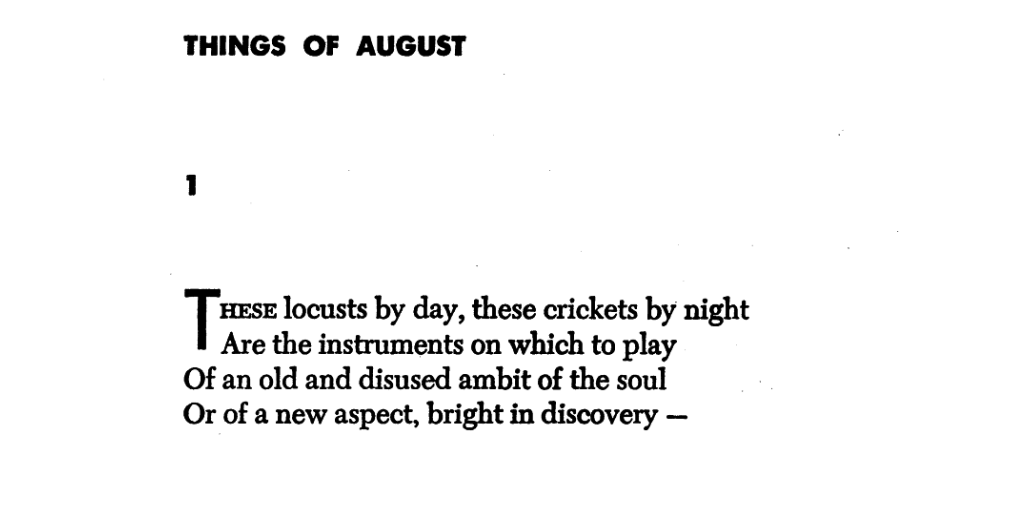
Poetry Friday: "Things of August" by Wallace Stevens
Nix the Comfort Zone.
Thursday, July 14, 2022
Poetry Friday: "Time to Hear Ourselves Think"
Thursday, June 16, 2022
Poetry Friday: I love the father my husband is
Thursday, June 02, 2022
Poetry Friday: I'm hosting!
The Lake Isle of Innisfree
by William Butler Yeats
I will arise and go now, and go to Innisfree,
And a small cabin build there, of clay and wattles made;
Nine bean-rows will I have there, a hive for the honey-bee,
And live alone in the bee-loud glade.
And I shall have some peace there, for peace comes dropping slow,
Dropping from the veils of the morning to where the cricket sings;
There midnight’s all a glimmer, and noon a purple glow,
And evening full of the linnet’s wings.
I will arise and go now, for always night and day
I hear lake water lapping with low sounds by the shore;
While I stand on the roadway, or on the pavements grey,
I hear it in the deep heart’s core.
Friday, May 06, 2022
Poetry Friday: Billy Collins reads Lawrence Raab
Marriage
by Lawrence Raab
Years later they find themselves talking
about chances, moments when their lives
might have swerved off
for the smallest reason.
Thursday, April 28, 2022
Poetry Friday: "The Poet" by Jane Hirshfield
On the eve of the last day of National Poetry Month, I give you this gem from the marvelous poet Jane Hirshfield:
She is working now, in a room
not unlike this one,
the one where I write, or you read.
Her table is covered with paper.
The light of the lamp would be
tempered by a shade, where the bulb's
single harshness might dissolve,
but it is not; she has taken it off.
Friday, April 08, 2022
Poetry Friday: It's National Poetry Month and I've got the Poetry Month Blues
Janice has the roundup this week at Salt City Verse.
Friday, March 25, 2022
Poetry Friday: Gerard Manley Hopkins
![]() |
The Annunciation by Henry Ossawa Tanner |
Feast! Today is the Solemnity of the Annunciation. I've been running behind on everything this week, including getting a Poetry Friday post together, but this morning Atticus suggested "The Blessed Virgin Compared to the Air We Breathe" by Gerard Manley Hopkins.
Ah. Yes. Perfect.
Hopkins has always fascinated me. From Poetry Foundation:
Gerard Manley Hopkins is considered to be one of the greatest poets of the Victorian era. However, because his style was so radically different from that of his contemporaries, his best poems were not accepted for publication during his lifetime, and his achievement was not fully recognized until after World War I. Hopkins’s family encouraged his artistic talents when he was a youth in Essex, England. However, Hopkins became estranged from his Protestant family when he converted to Roman Catholicism. Upon deciding to become a priest, he burned all of his poems and did not write again for many years. His work was not published until 30 years after his death when his friend Robert Bridges edited the volume Poems.
The Poetry Foundation says:
According to his own testimony Hopkins was subject to melancholy all his life, but his “terrible pathos,” as Dixon called it, is most obvious in these late sonnets. Following Saint Ignatius, Hopkins defined “spiritual sloth” or “desolation” as “darkness and confusion of soul ... diffidence without hope and without love, so that [the soul] finds itself altogether slothful, tepid, sad, and as it were separated from its Creator and Lord.” Called acedia in Latin, this sin is differentiated from physical sloth by the fact that the victim realizes his predicament, worries about it, and tries to overcome it.
The sense of coldness, impotence, and wastefulness evident in Hopkins’s religious poetry of the 1860s is an important feature of acedia, but by far the most important is “world sorrow,” the predicament lamented in Hopkins’s “No worst, there is none” (1885).
See? I told you I was a party killer.
Because today is not about death and grief, but about life and a particular kind of celebration, so it's time to switch gears a bit. At the Annunciation, Mary was asked if she would say yes to the incomprehensible. (I do feel compelled to point out that this was, in its way, a kind of death, the death of the life Mary had known but hey, we melancholics can relate everything to death. It's a talent.) The Annunciation was also a turning point and a model for us: Mary said yes to a staggering request. What am I asked to say yes to? When God asks the incomprehensible of me, do I remember Gabriel's words to Mary: "Do not be afraid"? On a good day, I both say yes and am not afraid. Not every day is a good day but today I'm shaking off my melancholic tendencies and party-killing ways and I will celebrate accordingly. I will not be afraid, I will say yes, I will take comfort in the Comforter and find relief in Mary's ways.
Here are some excerpts from Hopkins's beautiful poem, "The Blessed Virgin Compared to the Air We Breathe":
This air, which, by life’s law,My lung must draw and draw
Now but to breathe its praise,
Minds me in many ways
Of her who not only
Gave God’s infinity
Dwindled to infancy
Welcome in womb and breast,
Birth, milk, and all the rest
But mothers each new grace
(Read the whole thing here, at the website of the International Hopkins Association.)
~~~~~~~~~~
Thursday, March 17, 2022
Poetry Friday: "Time" by Laura Landis Laedlein
I went looking for a poem about time because, as we are all painfully aware, this week is our first week on Daylight Saving Time.
(Not "Daylight Savings Time," because it is, as Kent of VEEP so helpfully points out, "neither plural nor possessive.")
Daylight Saving Time provokes all manner of thought and emotion in me. I get tired, I rail and rage against this attempt to harness and control the uncontrollable. After a day or two of (exhausting) railing and raging, I collapse. I nap. Then I ponder time and the endless ways we reflect on it. My hunt for "poems about time" led me to this one in the 1923 issue of Poetry Magazine and also left me wondering who Laura Landis Laedlein was. All I could find out about her was this brief bio in the magazine: "Miss Laura Landis Laedlein is a business woman in Williamsport, Pa."
Hmm.
I hope that Laura Landis Laedlein made the most of her time in Williamsport, Pennsylvania. I hope she had the time of her life writing poetry and that she spent time rejoicing when this one was published in Poetry magazine. I hope her time as a business woman was successful and that perhaps she saw a kindred spirit in Wallace Stevens, he of insurance/poetry fame. I hope she knows she did what poets do: she touched eternity in a small, human way — she reached out, hand stretched across so many decades, and handed me this poem, a hundred years after its publication, on a day when I was thinking about time and its odd and poignant hold on us.
Thank you, Miss Laura Landis Laedlein, for taking the time to write a poem. Thank you for setting aside time to submit your poem to Poetry magazine. Thank you for whatever else you did in Williamsport, Pennsylvania and I hope that your time on this earth was, as Mary Oliver would want it to be for you, wild and precious.
Time
by Laura Landis Laedlein
Across the day:
Hand-linked they run, and light-footed;
Swift-footed alway.
I see the procession of the years
Masked, they lean forward, and press onward,
A marching train.
I see the backward path centuries have come
To where I stand;
And, holding the present, touching eternities
With my hand.
Thursday, March 10, 2022
Poetry Friday: The Traveling Onion by Naomi Shihab Nye
In keeping with our hosts' food theme, I'm sharing this one from Naomi Shihab Nye. It's about onions but, of course, it's not really about onions. Or perhaps I should say it's not only about onions. Peel away its layers and see what you think.
The Traveling Onion
by Naomi Shihab Nye
When I think how far the onion has traveled
just to enter my stew today, I could kneel and praise
all small forgotten miracles,
Thursday, March 03, 2022
Poetry Friday: Dear March—Come in by Emily Dickinson
Tuesday, March 01, 2022
A Meaningful Lent: The Monstrously Long Post
Ready to head into the desert? You'll find ideas in my newest book, The Companion Book of Catholic Days: A Guide to Feasts, Saints, Holy Days, and Seasons. (You can find it here, at The Word Among Us, and here, on Amazon.)
Friday, February 25, 2022
Poetry Friday: Wild Gratitude
Today I'm sharing Edward Hirsch's "Wild Gratitude" because I keep learning and relearning what it means to offer praise and thanksgiving. Gratitude doesn't look the same from year to year, month to month, day to day, or even minute to minute. Sometimes I feel overwhelmed by the gifts that have made their way into my life and other days I'm holding on to gratitude as if it's a gossamer strand I could lose if I blink. Those are the days I most need to sit down with my journal and simpy write, Thank you, thank you, thank you. Oh, and most of all? Thank you.
Wild Gratitude
by Edward HirschTonight when I knelt down next to our cat, Zooey,
And put my fingers into her clean cat’s mouth,
And rubbed her swollen belly that will never know kittens,
And watched her wriggle onto her side, pawing the air,
And listened to her solemn little squeals of delight,
I was thinking about the poet, Christopher Smart,
Who wanted to kneel down and pray without ceasing
In every one of the splintered London streets,
(Read the whole poem at Edward Hirsch's website.)
Friday, February 11, 2022
Poetry Friday: Billy Collins again (not because I forgot, but because he deserves it)
It's Billy Collins again.
I could lie and say that I forgot I shared a Billy Collins poem last week, but that's not true. I just can't get enough of Billy Collins (that's always been true).
So, not because I've forgotten, but rather because I love "Forgetfulness" (and can relate), here it is:
Forgetfulness
by Billy CollinsThe name of the author is the first to go
followed obediently by the title, the plot,
the heartbreaking conclusion, the entire novel
which suddenly becomes one you have never read,
never even heard of,
as if, one by one, the memories you used to harbor
decided to retire to the southern hemisphere of the brain,
to a little fishing village where there are no phones.
~~~~~~~~~~
Don't forget to visit Linda Baie, who has the roundup at TeacherDance.
Friday, February 04, 2022
Poetry Friday: "Days" by Billy Collins
Days
by Billy Collins
mysteriously placed in your waking hand
or set upon your forehead
moments before you open your eyes.
Elisabeth has the round-up at Unexpected Intersections.


_-_The_Annunciation_-_Google_Art_Project.jpg)