Friday, June 29, 2012
Poetry Friday: I'm Sorry, Atticus, I Just Can't Do It
At least not very well. Not today.
Given that we were recently in Florida, and given that Wallace Stevens has always been one of Atticus's favorite poets, and given that it is Poetry Friday, Atticus suggested that I post a Stevens poem, "O Florida, Venereal Soil" and he suggested that I do it "without groping after some epistemological objective categorizing of the deeply subjective reactions reflected in the verse."
Gee, do I do that?
He went on to say, quoting John Keats, "In other words, 'be capable of being in uncertainties, mysteries, doubts, without any irritable reaching after fact and reason....'"
But, um, I always do that irritable reaching. I thought he found it endearing. And I so often do it on Poetry Fridays.
But not always, really. Right? I am highly qualified to live in uncertainty, mystery and doubt. I'm a Catholic. It doesn't get more mysterious than that. And I sometimes post just the poem, sans any torturous reflection on my part: such as here and here and here and here and here and here. (Methinks I protest too much?)
I am capable, as William Hurt said in this clip, of just letting art flow over me.
But, I can't post about Wallace Stevens -- I can't even think about Wallace Stevens -- without thinking. Long and hard, about a number of things. His life as both insurance executive and poet is fodder for scrutiny, and that's before we even get to his body of work. He was an interesting, perplexing human being. And I can't think about Florida, and travel, and real life vs. vacations, and how randomly we all seem to land in various geographical areas without that sparking some reflection.
And of course, all of that leads to a new stream of thought: Stevens isn't alone as poetry-writing insurance executive. The 13th U.S. Poet Laureate Ted Kooser had the same Paper-Pusher-By-Day-Deep-Thinker-By-Night existence (though they are obviously extremely different types of poets). And that brings me to the poem posted at The Writer's Almanac today -- Kooser's "So This Is Nebraska" ... and that means I've gone full circle from Nebraska to Florida and home again.
Not only that, but on today's Writer's Almanac page, there is also a mention of the birthday of Antoine de Saint-Exupéry, and that brings me to a quote from The Little Prince: "It is only with the heart that one can see rightly; what is essential is invisible to the eye."
And if I believe that, I must be capable of being in uncertainties, mysteries, doubts ... and I am capable of that. Just not, clearly, capable of posting a Wallace Stevens poem without saying something. And nothing.
And, sadly, now, I'm thinking I should've just posted some Keats.
Maybe next week.
~~~~~~~~~~~~
The Poetry Friday round up is at Paper Tigers.
Friday, March 31, 2017
Poetry Friday: "A bird’s cry, at daylight or before, In the early March wind...."
Without further ado, here is the genius of my husband, Wallace Stevens, and spring:
Not Ideas About the Thing but the Thing Itself
by Wallace Stevens
At the earliest ending of winter,
In March, a scrawny cry from outside
Seemed like a sound in his mind.
He knew that he heard it,
A bird’s cry, at daylight or before,
In the early March wind.
(Read the whole thing here, at The Poetry Foundation.)
~~~~~
The wonderful Amy Ludwig VanDerwater has the round up today at The Poem Farm.
Thursday, August 04, 2022
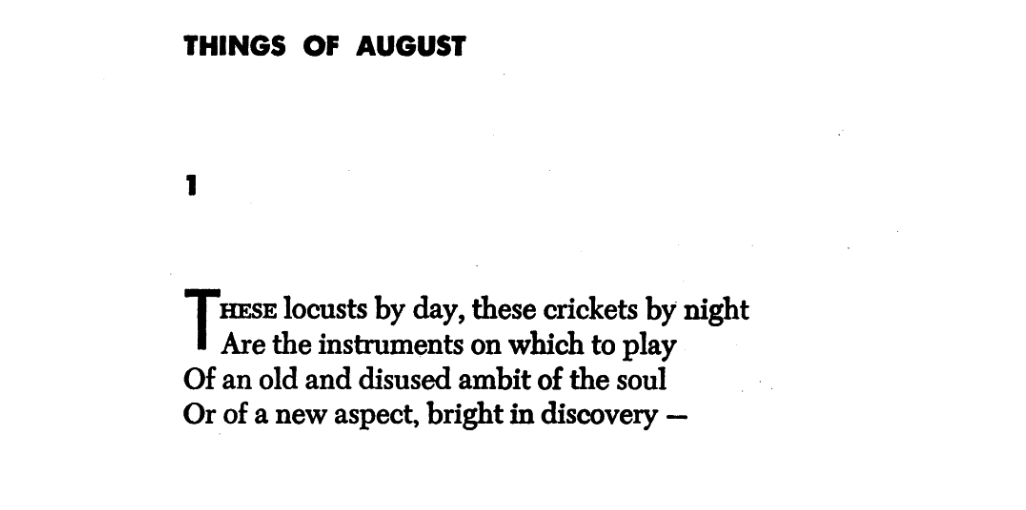
Poetry Friday: "Things of August" by Wallace Stevens
Nix the Comfort Zone.
Friday, August 07, 2009
Poetry Friday: The Poem That Took the Place of a Mountain
I've mentioned Wallace Stevens before.Once, at Sara Lewis Holmes' Read - Write - Believe, I said of him, when comparing and contrasting with Billy Collins:
Billy Collins is like the pal you love and go out with for coffee ... the friend with whom you never have a conflict, because you always know exactly what he means. And he gets you, too, and you love him for that. And then you order more coffee and sigh and think, "If only everything could be this easy."
Wallace Stevens is like your inscrutable uncle, who isn't always kind, and sometimes doesn't seem to want you around, but who's so complex and interesting that you keep having him over. And when you pin him down on something, and whisper to your mother, who's sitting next to you, that now you know why he's like this, he smiles cryptically, and looks away.
Your coffee friend would, of course, be insulted at being analyzed, but your uncle practically begs for it.
(Thanks, Sara, for reminding me awhile back that I said that, and thanks for finding me italicizable.)
I am not trying to be contrary, but contrary to popular (read: my) belief, today's poem by Wallace Stevens isn't of the inscrutable stripe. Atticus stumbled on it last night, and I'd never seen it before. It's amazing. It needs very little comment, so of course I'll comment. I think that anyone who has ever been devastated, overwhelmed changed, gobsmacked, or otherwise affected by a piece of writing, or anyone who has ever struggled to find exactly the right word for the moment, the image, the feeling, or the desire, can understand this poem.
The Poem That Took the Place of a Mountain
There it was, word for word,
The poem that took the place of a mountain.
He breathed its oxygen,
Even when the book lay turned in the dust of his table.
It reminded him how he had needed
A place to go to in his own direction,
(Read the entire poem here.)
Tricia at The Miss Rumphius Effect is hosting Poetry Friday today.
Friday, September 04, 2020
Poetry Friday: "Thirteen Ways of Looking at an Interruption"
(With apologies to Wallace Stevens. Original lines from his poem, Thirteen Ways of Looking at a Blackbird are in italics. Obviously, all the good lines are his. The children, however, are mine.)
I
In the stillness of night,
The only moving thing
is a child.
II
I was of three minds:
sleep, motherhood, sleep.
III
I pretended not to care that I was awakened.
It was a small part of the pantomime.
There is my "to do" list, and then there is God's.
These are not the same thing.
IV
A man and a woman
Are one.
A man and a woman and a child
Are one.
Add, mix and stir: my daughters' "to do" lists are mine.
V
I do not know which to prefer,
The beauty of inflections
Or the beauty of innuendoes,
The life with the child
or the thought of that life.
VI
Chatter filled the long day
The company of children
Transformed a mood. Sometimes
for better. Sometimes ... not.
VII
O, dear control-freak-self,
Why do you imagine a different life?
Do you not see how the life
you've been given is unspeakable gift?
VIII
I know of a tidy life,
of elegance, rhythm and control.
But I know, too, That a child is involved
In what I know.
IX
When my children have grown,
They will mark the edge
Of one of many circles.
I will be grateful for their imprint.
X
At the sight of children
I used to say, "Not for me, please.
An unwelcome interruption."
But something shifted. I gave myself
Over to motherhood, and held on tight.
XI
Once, a fear pierced me,
that I would never rise to this task,
would not die to self.
XII
3:20 a.m.: A nightmare. She needs me more
than I need this sleep.
I rise. I go.
A child will not wait for morning.
XIII
It was nighttime all day.
I loved her and I was going to love her.
The child sat entwined in my limbs.
The interruption sweetly complete.
~~~~~
Find more posts about Wallace Stevens here.
Friday, January 09, 2015
Poetry Friday: Wallace Stevens
Friday, September 27, 2013
Poetry Friday: When Was the Last Time You Laughed at Anything to Do With Wallace Stevens?
Two very short poems that are rather irresistible.
Indeed, they are so short I can't reproduce them here (copyright issues, you know), but trust me when I say you should click over to Excerpt from Wallace Stevens' Diary, and Excerpt from Wallace Stevens' Diary, Part II, by Jonah Winter.
~~~~~
The round up this week is at The Poem Farm.
Thursday, September 26, 2024
Poetry Friday: Thirteen Ways of Looking...
I'm joining the Poetry Pals/Sisters/Princesses for their monthly challenge. Tanita shared this prompt for September:
Poetry Peeps! You’re invited to our challenge for the month of September! Here’s the scoop: We’re wandering through Wallace Stevens’ “13 Different Ways of Looking…” at something. Maybe it’s not 13 ways – maybe it’s only seven. Maybe it’s not a blackbird or anything alive, but something inanimate. Whatever happens, your way of looking will be different than mine, and I’m here for it. Are you in? Good! You have a month to craft your creation and share it on September 27th in a post and/or on social media with the tag #PoetryPals.
I'm cheating a little because I wrote this one a while ago, when my daughters were young. And saying I "wrote" it is a wee bit of a stretch since I borrowed lines from Stevens and interspersed them throughout my version. But I've always liked it and thought it would be fun to share it again, especially given this month's challenge.
(Original lines from Thirteen Ways of Looking at a Blackbird are in italics. All the good lines belong to Stevens, but hey, the children are mine.)
Thirteen Ways of Looking at an Interruption
Karen Edmisten
(with apologies and thanks to Wallace Stevens)
I
In the stillness of night,
The only moving thing
is a child.
II
I was of three minds:
sleep, motherhood, sleep.
III
I pretended not to care that I was awakened.
It was a small part of the pantomime.
There is my "to do" list, and then there is God's.
These are not the same thing.
IV
A man and a woman
Are one.
A man and a woman and a child
Are one.
Add, mix and stir: my daughters' "to do" lists are mine.
V
I do not know which to prefer,
The beauty of inflections
Or the beauty of innuendoes,
The life with the child
or the thought of that life.
VI
Chatter filled the long day
The company of children
Transformed a mood. Sometimes
for better. Sometimes ... not.
VII
O, dear control-freak-self,
Why do you imagine a different life?
Do you not see how the life
you've been given is unspeakable gift?
VIII
I know of a tidy life,
of elegance, rhythm and control.
But I know, too, That a child is involved
In what I know.
IX
When my children have grown,
They will mark the edge
Of one of many circles.
I will be grateful for their imprint.
X
At the sight of children
I used to say, "Not for me, please.
An unwelcome interruption."
But something shifted. I gave myself
Over to motherhood, and held on tight.
XI
Once, a fear pierced me,
that I would never rise to this task,
would not die to self.
XII
3:20 a.m.: A nightmare. She needs me more
than I need this sleep.
I rise. I go.
A child will not wait for morning.
XIII
It was nighttime all day.
I loved her and I was going to love her.
The child sat entwined in my limbs.
The interruption sweetly complete.
Wednesday, April 14, 2010
Thirteen Ways of Looking at an Interruption
by Karen Edmisten,
with apologies to Wallace Stevens
(Original lines from his poem, Thirteen Ways of Looking at a Blackbird are in italics. Obviously, all the good lines are his. The children, however, are mine.)
I
In the stillness of night,
The only moving thing
is a child.
II
I was of three minds:
sleep, motherhood, sleep.
III
I pretended not to care that I was awakened.
It was a small part of the pantomime.
There is my "to do" list, and then there is God's.
These are not the same thing.
IV
A man and a woman
Are one.
A man and a woman and a child
Are one.
Add, mix and stir: my daughters' "to do" lists are mine.
V
I do not know which to prefer,
The beauty of inflections
Or the beauty of innuendoes,
The life with the child
or the thought of that life.
VI
Chatter filled the long day
The company of children
Transformed a mood. Sometimes
for better. Sometimes ... not.
VII
O, dear control-freak-self,
Why do you imagine a different life?
Do you not see how the life
you've been given is unspeakable gift?
VIII
I know of a tidy life,
of elegance, rhythm and control.
But I know, too, That a child is involved
In what I know.
IX
When my children have grown,
They will mark the edge
Of one of many circles.
I will be grateful for their imprint.
X
At the sight of children
I used to say, "Not for me, please.
An unwelcome interruption."
But something shifted. I gave myself
Over to motherhood, and held on tight.
XI
Once, a fear pierced me,
that I would never rise to this task,
would not die to self.
XII
3:20 a.m.: A nightmare. She needs me more
than I need this sleep.
I rise. I go.
A child will not wait for morning.
XIII
It was nighttime all day.
I loved her and I was going to love her.
The child sat entwined in my limbs.
The interruption sweetly complete.
~~~~~
More about Wallace Stevens here.
Friday, January 04, 2013
Poetry Friday: T.S. Eliot
(This just might be -- I'm not saying it is, but it could be -- a four-year-old post that is just as applicable today as it was in January of 2009, as we crept toward the Feast of the Epiphany.)
Sometimes, on a Thursday night, I plop down on the couch, look at Atticus and ask, "What do I want to post for Poetry Friday tomorrow?"
He always has an erudite reply and an intriguing suggestion. He's an intelligent, fascinating man. I used to fancy myself equally intelligent and fascinating (we-e-elll, maybe not equally but close enough to hold my own in a good poetry discussion), and I considered us a perfect match. Several years back, I could keep up with all of his Wallace Stevens talk. Then I had children and for a few years, when sleep was so elusive, my mind started to slip. "The Emperor of Ice Cream" began to sound more like a character on the Disney channel than existential observation.
Anyway, in answer to the learned suggestions of Atticus, I usually stare into space a moment, take a sip of cabernet and say something like, "I think I'll write a poem about Putty," or "I'll just do Billy Collins again."
These exchanges remind me of a scene from Annie Hall in which Woody Allen and Diane Keaton are in a bookstore, and he says, "Here, I think you should read these, uh, instead of that cat book."
So, in order not to read a cat book today (though I must add the disclaimer that my beloved Billy Collins is not a cat book -- the metaphor refers only to my state of mind and has nothing to do with his poetry, which I much adore, and it is equally removed from cats, creatures I like very much), I am posting Atticus's suggestion: Journey of the Magi, by T.S. Eliot.
At first I groaned, "Ohhh, Eliot ... I don't know if I have the energy for Eliot." But then, I asked myself, "When did you last read Journey of the Magi?" And I had to honestly answer myself, "I don't know. It may have been several Emperors of Ice Cream ago." So, I read it. And, as always happens, I was mesmerized. How does he do that? How did he carry around the reputation of being too scholarly and too philosophical to write poetry, and then do that? It's so good, such a perfect melding of earthly earthiness and the supernatural. Like Jesus Himself, really. Eliot captures that down-to-your-bones discomfort, the squirming and the revelation, the discovery that this isn't really my home. That knowledge which at first is both comforting and terrifying.
Go here, to the Poetry Foundation, to read more about Eliot.
Journey of the Magi
by T.S. Eliot
'A cold coming we had of it,
Just the worst time of the year
For a journey, and such a long journey:
The ways deep and the weather sharp,
The very dead of winter.'
And the camels galled, sorefooted, refractory,
Lying down in the melting snow.
There were times we regretted
The summer palaces on slopes, the terraces,
...
All this was a long time ago, I remember,
And I would do it again, but set down
This set down
This: were we led all that way for
Birth or Death? There was a Birth, certainly,
We had evidence and no doubt. I had seen birth and death,
But had thought they were different; this Birth was
Hard and bitter agony for us, like Death, our death.
We returned to our places, these Kingdoms,
But no longer at ease here, in the old dispensation,
With an alien people clutching their gods.
I should be glad of another death.
...
The full text of the poem is here, where you can also hear Eliot read it.
~~~~~
The round up today is being hosted by Matt Forrest Esenwine at Radio, Rhythm & Rhyme.
Friday, January 02, 2009
Poetry Friday: Of Brain Cells and Eliot
Sometimes, on a Thursday night, I plop down on the couch, look at Atticus and ask, "What do I want to post for Poetry Friday tomorrow?"He always has an erudite reply and an intriguing suggestion. He's an intelligent, fascinating man. I used to fancy myself equally intelligent and fascinating (weeelll, maybe not equally but close enough to hold my own in a good poetry discussion), and I considered us a perfect match. Several years ago, I could keep up with all his Wallace Stevens talk. Then I had children. For a few years, when sleep was so elusive, my mind started to slip. The "Emperor of Ice Cream" began to sound like a character on the Disney channel.
Anyway, in answer to the learned suggestions of Atticus, I usually stare into space a moment, take a sip of wine and say something like, "I think I'll write a poem about Putty," or "I'll just do Billy Collins again."
These exchanges often remind me of a scene from Annie Hall in which Woody Allen and Diane Keaton are in a bookstore, and he says, "Here, I think you'd like to read this, uh, instead of that cat book."
So, in order not to buy a cat book today (though I must add the disclaimer that my beloved Billy Collins is not a cat book -- the metaphor refers to the state of my mind and has nothing to do with his poetry, which I much adore), I am posting Atticus's suggestion: Journey of the Magi, by T.S. Eliot.
At first I groaned, "Ohhh, Eliot ... I don't know if I have the energy for Eliot." But then, I asked myself, "When did you last read Journey of the Magi?" And I had to honestly answer myself, "I don't know. It may have been several Emperors of Ice Cream ago." So, I read it. And, as always happens, I was mesmerized. How does he do that? How did he carry around the reputation of being too scholarly and too philosophical to write poetry, and then do that? It's so good, such a perfect melding of earthly earthiness and the supernatural. Like Jesus Himself, really. Eliot captures that down-to-your-bones discomfort, the squirming and the revelation, the discovery that this isn't really my home. That knowledge which at first is both comforting and terrifying.
Go here, to the Poetry Foundation, to read more about Eliot.
Journey of the Magi
by T.S. Eliot
'A cold coming we had of it,
Just the worst time of the year
...
All this was a long time ago, I remember,
And I would do it again, but set down
This set down
This: were we led all that way for
Birth or Death? There was a Birth, certainly,
We had evidence and no doubt. I had seen birth and death,
But had thought they were different;
...
The full text of the poem is here.
The Poetry Friday roundup is at A Year of Reading.
Thursday, July 19, 2007
Meme: 8 Things about my husband
1. Atticus comes from a family of twelve children. His mother adored babies. Clearly. He has a huge family, relatives we don't even know about.
I, on the other hand, grew up in a family of three children, and each of my parents was an only child. Therefore, I grew up without aunts, uncles or cousins. I can count my entire family on two hands.
2. Atticus didn't used to eat much candy, but then I introduced him to the joys of chocolate with coffee. He still doesn't eat a lot, but he can appreciate a good combo when he tastes it.
He introduced me to the best homemade spaghetti sauce ever, his mother's recipe. He still makes it, and I still love it.
3. He's the gardener. It's thanks to Atticus that we have flowers on the front porch and tomatoes in the back yard. It is only thanks to Atticus that I even know what a Mexican sunflower looks like, that four o'clocks attract hummingbirds (and hummingbird moths,) and that Amaranthus is a plant, not a drink.
I've been known not to garden.
4. Atticus loves to run. Miles at a time.
I, on the other hand, decidedly do not love to run. I've tried it, but the distracting popping sounds from my knee whisper, "Go home ... sit down ... read a good book ... chocolate ... coffee ... " Once settled in with said good book, the voices begin to say things like, "You could really stand to lose a few pounds."
I blame him for the voices.
5. Atticus was a Marine. I grew up as an Air Force brat. However, neither of us is currently in the military.
6. Atticus's favorite poet is Wallace Stevens. Mine is Emily Dickinson. We both liked e.e. cummings, when we met, but Atticus never went through the affected-schoolgirl-phase of writing everything without capital letters in homage to e.e.
i did.
7. Atticus knows everything. Seriously. Ask him a question. Name an obscure figure from history. He's on it. He already knows and can tell you more than Wikipedia will ever dream of knowing, without stammering, "Umm ... yeah ... I've heard of that guy ...." Just try to get through a round of Trivial Pursuit with him without stomping away in disgust at the uneven playing field. His students think he's a genius. He is.
I'm not.
8. Atticus and I are astonishingly different. We made an unlikely couple. People thought it would never last, for reasons that would take seventeen memes to detail.
It lasted. And we're so happy it did.
If you're married, you're tagged.
Thursday, October 03, 2024
Poetry Friday: "First Fall" by Maggie Smith
by Maggie Smith
I’m your guide here. In the evening-dark
morning streets, I point and name.
Look, the sycamores, their mottled,
paint-by-number bark. Look, the leaves
rusting and crisping at the edges.
I walk through Schiller Park with you
on my chest. Stars smolder well
into daylight. Look, the pond, the ducks,
Sunday, February 14, 2021
Bits and Pieces of Our Days
“I have only made this letter longer because I have not had the time to make it shorter.”
— Blaise Pascal
* A year ago on Valentine's Day I didn't know what was coming. (Well, I guess by then we'd all heard of the coronavirus entering the country but I was still naive enough or stupid enough or hopeful enough to think it would be handled well and contained.) On this day last year I was blogging about creating black-out poetry, because I never have a lot to say about Valentine's Day. Atticus and I often forget that Valentine's Day is approaching, though we've always bought chocolate for our daughters because any occasion calling for chocolate will be observed in the Edmisten household. Our anniversary is at the end of January so we've just finished trying to figure out when to schedule the celebration of that (because —hello! — school year in full swing and National Honor Society induction meetings and speech season and my schedule in addition to his ... you get the picture) when Valentine's Day rolls around and we're left looking at each other and saying, "Again? We just celebrated our love, for Pete's sake. Now we have to come up with another creative observance?"
Okay, we've never actually said that but that's how it feels. It's not that we don't like romance. We just don't like having it dictated to us on a timetable. I'm a Questioner (thanks, Gretchen Rubin, for coming up with the Four Tendencies. I kind of love you for this.) Questioners need to have reasons to do things and I've always rebelled against being told I should express my love for my husband in a certain way on a certain day. I'm always perfectly happy to express my love for Atticus on Valentine's Day, but my rebel wing bristles a little at the world saying I should.
Anyway, here we are on Valentine's Day, 2021, and Atticus and I told each other not to do anything at all. "Nothing, do you hear me?" He said he heard me but he also bought me a little box of chocolates and gave me a homemade Valentine. I gave him a card and told him he should buy that Wallace Stevens biography that he wants.
So, happy feast of Saints Cyril and Methodius, Atticus.
~~~~~~~~~~
* Recent reading:
The Seven-and-a-half Deaths of Evelyn Hardcastle by Stuart Turton (fun distraction)
Life is in the Transitions by Bruce Feiler (a number of interesting stories about just how non-linear life is)
Anxious People by Fredrik Backman (took a little bit to get into it but it ended up being very Backman-ish in its blend of humor and poignancy.)
The pandemic robbed me of the joy of reading for a while but I've been getting back into a groove, I'm happy to report.
Favorite reads from late 2020 that I probably haven't mentioned here:
Piranesi by Susanna Clarke (haunting and stunning)
Hamnet by Maggie O'Farrell (she writes of grief with such piercing truth)
Book recommendations?
~~~~~~~~~~
* December and January were a blur of Covid-related sadness and shock, prayers, practical attending to my parents, coming to grips with their reality, near-daily surprises and difficult decisions about their conditions, and re-learning that miracles happen. The blur this week is one of preparation: they are going home! My father, since early December, has spent time in a hospital, then a specialty hospital, and then a skilled care facility while my mother has been in a skilled care facility for the last six weeks. They are returning home, not unscathed by Covid, but with hope for the years to come. I am grateful beyond words.
All in all, not a bad Valentine's Day gift.
Thursday, March 17, 2022
Poetry Friday: "Time" by Laura Landis Laedlein
I went looking for a poem about time because, as we are all painfully aware, this week is our first week on Daylight Saving Time.
(Not "Daylight Savings Time," because it is, as Kent of VEEP so helpfully points out, "neither plural nor possessive.")
Daylight Saving Time provokes all manner of thought and emotion in me. I get tired, I rail and rage against this attempt to harness and control the uncontrollable. After a day or two of (exhausting) railing and raging, I collapse. I nap. Then I ponder time and the endless ways we reflect on it. My hunt for "poems about time" led me to this one in the 1923 issue of Poetry Magazine and also left me wondering who Laura Landis Laedlein was. All I could find out about her was this brief bio in the magazine: "Miss Laura Landis Laedlein is a business woman in Williamsport, Pa."
Hmm.
I hope that Laura Landis Laedlein made the most of her time in Williamsport, Pennsylvania. I hope she had the time of her life writing poetry and that she spent time rejoicing when this one was published in Poetry magazine. I hope her time as a business woman was successful and that perhaps she saw a kindred spirit in Wallace Stevens, he of insurance/poetry fame. I hope she knows she did what poets do: she touched eternity in a small, human way — she reached out, hand stretched across so many decades, and handed me this poem, a hundred years after its publication, on a day when I was thinking about time and its odd and poignant hold on us.
Thank you, Miss Laura Landis Laedlein, for taking the time to write a poem. Thank you for setting aside time to submit your poem to Poetry magazine. Thank you for whatever else you did in Williamsport, Pennsylvania and I hope that your time on this earth was, as Mary Oliver would want it to be for you, wild and precious.
Time
by Laura Landis Laedlein
Across the day:
Hand-linked they run, and light-footed;
Swift-footed alway.
I see the procession of the years
Masked, they lean forward, and press onward,
A marching train.
I see the backward path centuries have come
To where I stand;
And, holding the present, touching eternities
With my hand.
Sunday, January 05, 2014
Some Eliot for the Feast of the Epiphany
Sometimes, on a Thursday night, I plop down on the couch, look at Atticus and ask, "What do I want to post for Poetry Friday tomorrow?"
He always has an erudite reply and an intriguing suggestion. He's an intelligent, fascinating man. I used to fancy myself equally intelligent and fascinating (we-e-elll, maybe not equally but close enough to hold my own in a good poetry discussion), and I considered us a perfect match. Several years back, I could keep up with all of his Wallace Stevens talk. Then I had children and for a few years, when sleep was so elusive, my mind started to slip. "The Emperor of Ice Cream" began to sound more like a character on the Disney channel than existential observation.
Anyway, in answer to the learned suggestions of Atticus, I usually stare into space a moment, take a sip of cabernet and say something like, "I think I'll write a poem about Putty," or "I'll just do Billy Collins again."
These exchanges remind me of a scene from Annie Hall in which Woody Allen and Diane Keaton are in a bookstore, and he says, "Here, I think you should read these, uh, instead of that cat book."
So, in order not to read a cat book today (though I must add the disclaimer that my beloved Billy Collins is not a cat book -- the metaphor refers only to my state of mind and has nothing to do with his poetry, which I much adore, and it is equally removed from cats, creatures I like very much), I am posting Atticus's suggestion: Journey of the Magi, by T.S. Eliot.
At first I groaned, "Ohhh, Eliot ... I don't know if I have the energy for Eliot." But then, I asked myself, "When did you last read Journey of the Magi?" And I had to honestly answer myself, "I don't know. It may have been several Emperors of Ice Cream ago." So, I read it. And, as always happens, I was mesmerized. How does he do that? How did he carry around the reputation of being too scholarly and too philosophical to write poetry, and then do that? It's so good, such a perfect melding of earthly earthiness and the supernatural. Like Jesus Himself, really. Eliot captures that down-to-your-bones discomfort, the squirming and the revelation, the discovery that this isn't really my home. That knowledge which at first is both comforting and terrifying.
Go here, to the Poetry Foundation, to read more about Eliot.
Journey of the Magi
by T.S. Eliot
'A cold coming we had of it,
Just the worst time of the year
For a journey, and such a long journey:
The ways deep and the weather sharp,
The very dead of winter.'
And the camels galled, sorefooted, refractory,
Lying down in the melting snow.
There were times we regretted
The summer palaces on slopes, the terraces,
...
All this was a long time ago, I remember,
And I would do it again, but set down
This set down
This: were we led all that way for
Birth or Death? There was a Birth, certainly,
We had evidence and no doubt. I had seen birth and death,
But had thought they were different; this Birth was
Hard and bitter agony for us, like Death, our death.
We returned to our places, these Kingdoms,
But no longer at ease here, in the old dispensation,
With an alien people clutching their gods.
I should be glad of another death.
...
The full text of the poem is here, where you can also hear Eliot read it.
Sunday, August 04, 2013
My New Book, Deathbed Conversions: Finding Faith at the Finish Line, Is Available For Pre-order
I love what Our Sunday Visitor did with the cover. You're looking at (clockwise from top left) Patricia Neal, John Wayne, Oscar Wilde, and Gary Cooper. There are nine other stories in the book as well, among them poet Wallace Stevens, art historian Kenneth Clark (of Civilisation fame), and infamous gangster, Dutch Schultz. (This was a fascinating book to research and write.)
Deathbed Conversions will be published by OSV on September 25.